A Japanese pearl is an Akoya pearl: the species Pinctada fucata martensii, cultured in Japanese saltwater since 1893. Quality is judged on five factors. We call them the 5 S's: Shine (luster), Surface, Shape, Shade (overtones), and Size. Each is evaluated separately. Akoya pearls farmed in Japan today come from three prefectures only: Mie, Ehime, and Nagasaki. Other types you may see called "Japanese" (South Sea, Tahitian, Freshwater) are not Japanese in origin, regardless of where they were processed or sold.
Table of Contents
Why this guide exists
Amit Trading has sourced and sold Japanese Akoya pearls from Tokyo since 1969. Most of what you'll read online about "Japanese pearls" mixes facts about four different pearl types and calls them one thing. This guide separates them.
What's actually happening in the Japanese pearl market right now
Japan had over 2,000 Akoya pearl farms in 1990. Today, fewer than 600 remain, concentrated in three prefectures: Mie, Ehime, and Nagasaki. Annual production has collapsed from 67 tons to under 10 (Japan Fisheries Agency, 2023). What survives is harder to source, more expensive, and increasingly competitive at the wholesale level. The American Gem Trade Association reported Akoya wholesale prices up roughly 80% over recent harvests, with no sign of reversal. If you've been pricing pearls based on what they cost five years ago, the gap has widened. The rest of this guide walks through what that supply shock means for you, how to judge what you're being shown, and what the 2026 retail and wholesale ranges actually look like.
What makes a pearl Japanese: it's Akoya, and only Akoya
If a pearl was farmed in Japan, it's an Akoya. That's the short version. The long version is that some sellers and guides will bundle Akoya, South Sea, Tahitian, and Freshwater pearls together under the "Japanese pearls" label. That framing is wrong, and it costs buyers money.
A Japanese pearl is the cultured product of one specific oyster: Pinctada fucata martensii, the Japanese Akoya oyster. The species is small (8 to 10 cm shell width), thrives in cooler saltwater, and produces commercial pearls in the 5 to 9.5 mm size range (with seed-pearl sizes possible down to ~2 mm). The first cultured Akoya was patented by Kokichi Mikimoto in 1893 at Toba, Mie Prefecture, and that's where Japan's modern pearl industry began.
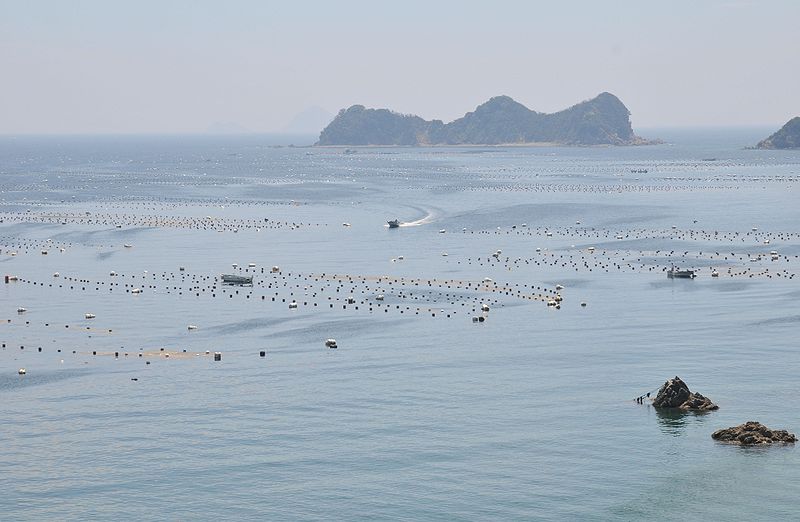
Where Akoya is farmed in Japan today
Akoya farming in Japan is now concentrated in three regions:
- Mie Prefecture (around Ago Bay and Toba). The historical heartland, where Mikimoto did his original work and where many of the country's oldest farms still operate.
- Ehime Prefecture (Uwajima Bay, Shikoku). Now Japan's second-largest production area by farmer count.
- Nagasaki Prefecture (Tsushima and the surrounding Kyushu coast). The largest single harvest by volume, with some farms producing over 500,000 pearls per cycle.
A small number of farms operate elsewhere along Japan's southern coast, but those three prefectures account for nearly all current commercial production. If someone tells you their Akoya is from a fourth Japanese region, ask which prefecture and which bay.
The other three pearl types are not Japanese
Every other pearl type you'll see for sale comes from somewhere else:
- South Sea pearls (white and golden) are farmed in Australia, Indonesia, the Philippines, and Myanmar from a different oyster, Pinctada maxima.
- Tahitian pearls come from French Polynesia, farmed from the black-lip oyster Pinctada margaritifera.
- Freshwater pearls are the most common type globally and are farmed almost entirely in Chinese lakes from mussels, not oysters.
None of these are Japanese in origin. Some get processed or finished in Japan. Kobe's drilling, sorting, and matching workshops are the world's best, and a lot of the global pearl trade still passes through them. But processing isn't origin. A South Sea pearl finished in Kobe is still a South Sea pearl.
Why the distinction actually matters when you're buying
- Origin is the foundation of value. A pearl's species, water temperature, and farming region set its size, color, and luster ceiling. You can't farm an Akoya look-alike from a freshwater mussel. The nacre structures are different, and so are the visual results.
- The supply story is dramatic. Japan's Akoya industry has contracted by roughly 70% over the last 30 years, driven by the 1996 outbreak of Akoya Oyster Disease, recurring mortality events in 2019 and 2020, an aging farmer population without successors, and climate change. See: The Death of Akoya Oysters in Japan and What It Means for You for the longer story. The practical effect: genuine export-grade Japanese Akoya is harder to source and more expensive than it was even three years ago. Sellers who haven't adjusted their inventory or their pricing are either showing you older stock or mislabeling something else as Akoya.
- Mis-labeling is common. Over 55 years in this trade, I've sat across the desk from buyers who paid Akoya prices for dyed Freshwater pearls, and from buyers who were told South Sea pearls were "Japanese" because they had been finished in Kobe. Neither is a fraud most of the time, just sloppy labeling at the retail end. The fastest way to protect yourself is to ask the seller for the species name. A real seller will know it without thinking.
The one-line rule
If you remember nothing else from this guide, remember this: when someone says "Japanese pearl," they mean Akoya. Anything else, ask for the species and the country.
Akoya in depth: nacre, luster, and the size ceiling
An Akoya pearl is layered nacre, secreted by the Pinctada fucata martensii oyster around an implanted nucleus over 8 to 12 months in cool Japanese saltwater. Nacre is alternating microscopic layers of aragonite (calcium carbonate) and conchiolin (an organic protein), each layer about half a micrometer thick. The Akoya oyster secretes thousands of these layers.
The reason Akoya luster looks the way it does comes down to layer geometry. Cool water slows the secretion process, which produces thinner, more uniform layers. Thinner layers diffract light more sharply. When you see the near-mirror reflection on a high-Shine Akoya, you're seeing thousands of these aligned layers acting as a partial mirror. Warmer-water pearls (South Sea, Tahitian) grow nacre faster with less uniform layering. They glow rather than flash. Different surface, different aesthetic.
Nacre thickness matters for longevity. A pearl with only 0.2 to 0.3 mm of nacre over its nucleus will dull and peel within a few years. Hanadama-certified strands document a minimum 0.4 to 0.8 mm cumulative thickness, verified by x-ray (depending on pearl size).
Commercial Akoya size sits in the 5.0 to 9.5 mm range, with 7.0 to 8.0 mm being the bulk of production. Smaller sizes down to about 2 mm exist as seed pearls used in specialty work. The Pinctada fucata oyster is small (about 8 to 10 cm shell width), and the implanted nucleus has a physical maximum the oyster can grow around. Above 9 mm, Japanese Akoya supply gets thin and prices step up sharply. For pearls 10 mm and larger, the market shifts to South Sea or Tahitian, which come from a larger oyster species (see the cross-type comparison further down).
Japan's pearl heritage: Mikimoto, Kobe, and Tokyo
Japan invented cultured pearling. Kokichi Mikimoto, the son of a noodle shop owner in Toba, Mie Prefecture, patented the technique in 1893 after roughly a decade of experiments. His first commercially viable round cultured pearl came in 1905. Within a generation, Japan had built an industry around the Akoya oyster that no other country could replicate at scale.
The geography of the modern industry maps the supply chain. Pearls are farmed in Mie, Ehime, and Nagasaki. They're processed (drilled, sorted, matched, strung) in Kobe. They're sold from Tokyo and Kobe to international buyers. Kobe became the world's pearl processing capital by accumulating decades of matching and finishing craft, passed down through specific workshops. The skill required to make a strand "read" as one strand (smooth size graduation, overtone continuity, flat lay) is built across generations. A South Sea pearl from Australia and a Tahitian from French Polynesia will both, more often than not, pass through Kobe before reaching the buyer.
Amit Trading sits inside this lineage as a Tokyo-based wholesaler. We opened in 1969, joined the Japan Pearl Exporters' Association (JPEA) in 1971, and have spent the last 55 years sourcing Akoya from the three production prefectures and selling internationally to retailers and private buyers. We're not in Mikimoto's generation. We're in the generation that lived through the 1996 Akoya Oyster Disease outbreak, the contraction from 2,000 farms to 600, and the supply-side reality check of the last decade. That's the position the rest of this guide is written from.

How to judge an Akoya pearl: the wholesaler's checklist
Akoya quality is judged on five factors. At Pearls.jp we call them the 5 S's: Shine (luster), Surface, Shape, Shade (overtones), and Size — the same dimensions captured in the internationally recognized GIA 7 Pearl Value Factors (size, shape, color, luster, surface, nacre, and matching). Each is a separate axis, evaluated on its own.
Most retail sellers compress the 5 S's into a single grade because it makes a transaction simpler. The A-AAA scale you'll see most often describes one of these factors only: Shine. When a seller stamps "AAA" on a strand, the label is grading the luster, not the strand overall — which is exactly the kind of inconsistency the CIBJO Pearl Blue Book exists to fix by publishing globally accepted pearl nomenclature and classification. A AAA-luster strand can still have a heavily marked Surface, the wrong Shade for the wearer, or sloppy matching. The AAA label tells you nothing about those.
Why don't more retailers teach the distinction? Some don't want to. The compressed grade lets them move inventory faster without educating the buyer. Others don't fully see the distinction themselves, because the training takes years of sorting at scale and most retail floors don't sort. Working wholesalers evaluate each S separately, in a specific order, under specific light. That order is what this section walks through.
The 5-second sort
When a strand or tray of loose Akoya lands in front of me, my eye goes to three things, in this order, in roughly five seconds:
- Shine (luster level)
- Surface (spot level)
- Shade (overtones)
Each season's hamaage (浜揚げ, the harvest brought up from the water) produces a wide quality spread across all five S's. The wholesale frame isn't "is this strand good." It's "which market is this strand for." A high-Shine, slightly cream strand and a high-Shine, neutral-white strand might land in the same quality category. They go to different buyers. The 5-second sort isn't a pass/fail. It's a routing decision. Once you understand that, you stop asking "is this AAA" and start asking "is this the right strand for the right wearer."
The light setup that actually matters
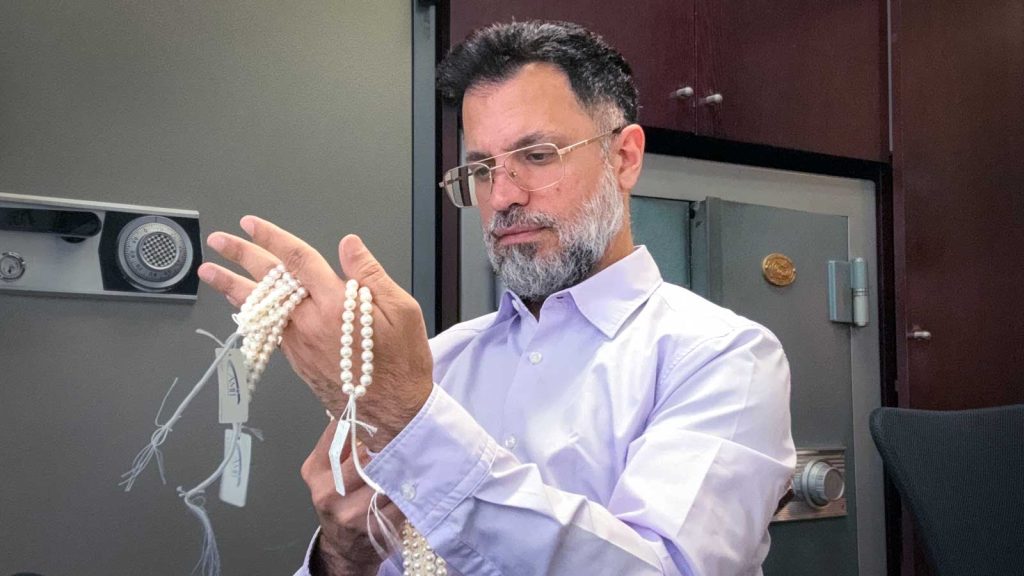
This part most retail guides skip, and it's why customers walk away confused. Pearls look different under different light. So we evaluate under two.
- Daylight window: for our own assessment. Indirect natural light gives the truest reading of luster and color.
- Daylight LED lamp: to simulate what the customer will see when they buy. Most retail environments use LED lighting, and we want to know how the strand performs in that environment before it leaves the office.
We tilt the strand three ways, each angle revealing something different:
| Angle | What it shows |
|---|---|
| Straight above | Shine sharpness: how crisp the reflected light is |
| 45° away from direct light | True body color and Shade (overtones), without the highlights washing them out |
| Below table height (in shade) | Whether the Shine holds in various lighting conditions. A real Akoya stays alive in a shaded setting. A weak one goes flat. |
A strand that looks good under bright store lighting but goes dull below the table is not a strand you want. It'll disappoint at a dinner table.
Shine (luster) — the only S the A-AAA scale grades
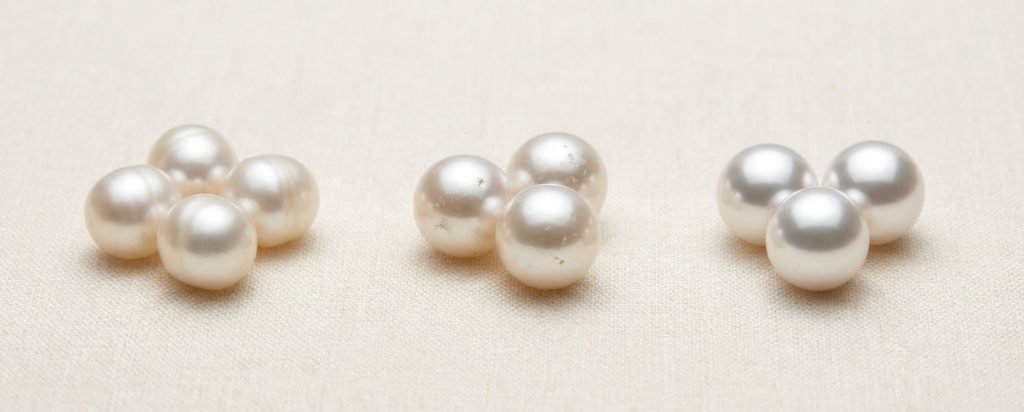
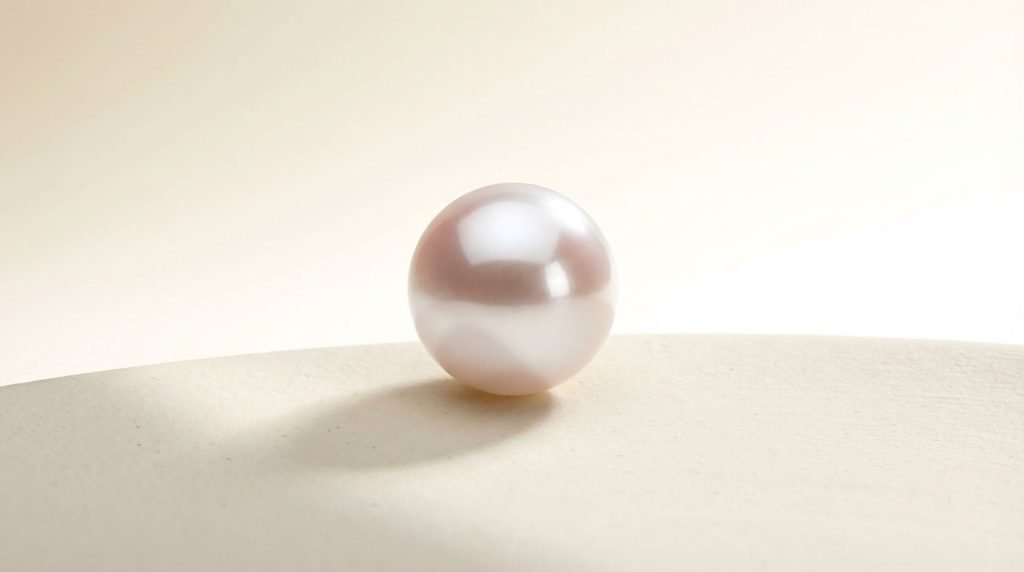
Shine is how sharply the pearl's surface reflects a point of light. Hold a strand under the daylight LED, look straight at it, and you should see a clear pinpoint reflection on each pearl. Almost like a tiny mirror. If what you see is a soft glow, the Shine is low and no certification will fix that.
In the Japanese trade this is called teri (テリ). When a Tokyo or Kobe wholesaler says a strand has good teri, they mean exactly this: the sharpness of the reflected light. Teri is the working vocabulary of the inside of the trade. AAA is the working vocabulary of the retail floor. Both describe the same factor; we just use the more precise one.
This is the only factor the A-AAA scale grades. When you see a strand labeled "AAA Akoya," that label is describing the Shine. It says nothing about the Surface, the Shape, the Shade, or the Size. Those are separate axes, evaluated separately.
Shine is the one factor I'd tell any buyer to learn first. Surface marks can be tolerated or hidden by knotting position. Shade (overtones) is a fit decision. Size is a budget decision. Shape adjusts what the strand reads as. Shine is the only factor where there's no recovery. A low-Shine Akoya is just a low-Shine Akoya forever.
The practical signal at our level: high-Shine strands route to the higher end of the market. Medium-Shine strands route to mass retail. Same harvest, same species, different destinations.
Surface — judged on its own, not via a grade
Surface is its own S, with its own evaluation. Sellers who tell you "AAA means clean surface" are conflating two factors. AAA describes Shine. Surface is judged independently.
Real Akoya pearls have small surface marks. Pinpricks, slight ringing, faint spotting. These are normal at very close range. The market's tolerance for them varies by region. Japanese domestic buyers tend to accept slightly more than European buyers do, and a competent matcher places the cleanest pearls at the front of the strand where they're most visible.
What we won't sell at Amit Trading is a strand with heavy or deep surface damage. The dealbreaker isn't quantity of small marks. It's depth and visibility. If you can see through the nacre into the nucleus (a faint dark spot showing through the pearl's outer layer), the nacre is too thin. The pearl will chalk or peel within a few years of wear. Same call if you can see areas of nacre that look broken or cratered. Walk away from those strands regardless of price. The seller is either inexperienced or unloading a tier that shouldn't be on the market.
Shade (overtones) — match the wearer, not the textbook
Most guides describe overtones (rose, silver, cream, champagne) as if they were quality grades. They're not. They're fit decisions. A high-luster strand with the wrong overtone for the wearer's skin tone is still the wrong strand.
What I've watched walk through our showroom over the years:
- Very cream overtones can clash with a wide range of skin tones and don't suit many regional markets. A strand with a heavy cream cast is harder to place, even when the luster is excellent.
- Very pink overtones can clash with Caucasian skin tones in particular, which already have natural pink undertones. The pearls and the skin compete instead of complementing, and the strand reads as off rather than soft.
- Neutral white with subtle silver-pink overtone is the most versatile across markets. It's the strand we recommend when a buyer can't bring the wearer to the showroom.
This is the kind of judgment you only get from sitting in a room while customers try strands against their neck. It doesn't show up in lab certifications. It's the reason buying remotely from a wholesaler who knows their inventory often beats buying in person from a retailer who doesn't.
The drill hole — what post-processing reveals
Most buyers never look at the drill holes. Always look. They reveal nothing about the pearl itself and everything about who handled it after harvest.
What I check on a strand:
- Consistency across the strand. Are the holes the same size on every pearl? Same axis? They should be.
- Chipping at the rim of the hole. A clean drill leaves a smooth edge. Chipping means corners were cut in finishing.
- Off-axis drilling. If a hole isn't centered, the pearl won't sit flat in the strand. It twists. The whole strand looks off even if each individual pearl is fine.
What this tells you: the finishing house's quality standards. A sloppy drill on a beautiful pearl is the seller telling you they cut corners somewhere. If they cut corners on the visible finishing, they probably cut corners on the matching too.
The trade's private rejects — shark skin and orange peel
Two surface conditions get rejected by working wholesalers that most retail buyers never notice. These are inner-trade terms. You won't hear them from a retail seller, partly because they don't see them, and partly because rejecting strands on these grounds would cut into their inventory.
- Shark skin: a fine, granular surface texture that catches the light unevenly. The pearl can have technically high luster but visual depth never reads right.
- Orange peel: a slightly dimpled surface that looks like, well, the skin of an orange under close examination.
Both are nacre crystallization issues from the formation stage. They can't be polished out. A trained wholesaler rejects strands with either condition. A retail seller may not even see them.
The practical test for a buyer: ask the seller "do you ever reject strands for shark skin?" The answer tells you whether you're talking to someone who actually sorts pearls or someone who just sells them.
Strand composition — the matching tell
A strand of 100 pearls should look like 100 versions of the same pearl. Good matching shows up in three places:
- Smooth size graduation. No jumps from pearl to pearl. The strand reads as a single curve from clasp to centre.
- Overtone consistency. The cast doesn't shift halfway through the strand from rose to silver. Same family of overtone, top to bottom.
- Drill alignment. When you lay the strand flat, every pearl sits level. No twists.
For Akoya earrings, the working tolerance is tight: under 0.15mm difference in diameter between the two pearls. Anything more visible and the asymmetry shows when worn. Strands have more room (the eye accepts gradual change along a necklace better than asymmetry between two earring pearls), but the same principles hold. Sloppy matching means pearls were collected from multiple harvests or multiple farms and forced together. The eye catches it even when each individual pearl is fine.
About certifications: Hanadama, AAA, and the trained eye
Here's where I disagree with most of what you'll read online.
AAA, used precisely, describes Shine only. As covered in the Shine section above, this is one of the 5 S's. Surface, Shape, Shade, and Size are separate axes the trade keeps separate. Sellers who extend the AAA label to cover all five factors at once are using it as a composite grade the trade itself doesn't use. Treat AAA as a Shine signal, not a strand-overall guarantee. Check the other 4 S's yourself, with the order and light setup above.
Hanadama is a separate private pearl certification issued by Pearl Science Laboratory (PSL) in Japan. It documents that a submitted strand meets specific thresholds (including a minimum 0.4mm cumulative nacre thickness, verified by x-ray, varying with pearl size). On paper, that sounds authoritative.
In our trade, professional buyers don't lean on it heavily, for three reasons:
- The lab is a private commercial business. Its model rewards volume of strands tested, not strictness of criteria. The incentives don't point toward maximum rigor.
- The grader is a person. Often a person with less working experience than the wholesaler evaluating the same strand. The certificate documents one person's judgment on one day.
- It documents a snapshot, not a buying decision. A Hanadama certificate doesn't tell you whether the strand is right for your buyer's skin tone, your market, or the price you're being asked to pay.
The working rule among Japanese wholesalers: a trained eye, calibrated against years of strands under the right light, outperforms any paper certification.
The honest position for buyers: certifications matter when you can't evaluate the strand yourself. They're a paper trail and they have value in that role. When you can stand in front of the strand with the light setup above and the order of evaluation above, the paper becomes redundant. Pay for the pearls, not the certificate.

Quick reference — the wholesaler's checklist
A scannable summary for the moment you're standing in front of a strand:
- The 5 S's framework: Shine, Surface, Shape, Shade, Size. Each judged separately.
- Light: daylight window plus daylight LED lamp
- Order of evaluation: Shine → Surface → Shade → Shape → Size → drill hole → matching
- Tilt 1 (straight above): sharpness of Shine
- Tilt 2 (45° away from light): body color and Shade (overtones)
- Tilt 3 (below table, in shade): does Shine hold in various lighting conditions?
- Shine: sharp pinpoint reflection, not soft glow. No recovery if low. Only this is graded A-AAA.
- Surface: pinpricks and light marks are natural. See-through nacre is a dealbreaker. Judged independently of Shine.
- Shade (overtones): match the wearer's skin tone, not an abstract "best."
- Shape: round, near-round, off-round, baroque. Separate axis.
- Size: millimetres. Separate axis. Drives budget more than quality.
- Drill hole: consistent across strand, no chipping, on-axis. Reveals the finishing house.
- Shark skin or orange peel texture: reject.
- Strand matching: smooth size graduation, overtone consistency, flat lay. Under 0.15mm for earring pairs.
- Certifications: useful when you can't see the strand. Redundant when you can.
If you can run a strand through the 5 S's under the right light, you don't need a third party to tell you what you're holding.
Akoya prices in 2026: what they actually cost
Akoya pricing has moved sharply over the last three years. With Japan's farm count down to under 600 and annual production at under 10 tons (see the market intro above), the American Gem Trade Association (AGTA) reported wholesale Akoya prices up roughly 80% over recent harvests. The price tag you'd have paid in 2022 is not the price tag in 2026.
Here's what an Akoya strand actually costs at our wholesale-direct retail tier, by size bracket. These ranges reflect typical 2026 market levels, accounting for the 5 S's combined. A higher-Shine, cleaner-Surface, better-matched strand within a bracket sits at the upper end. A lower-Shine, more-marked, less-matched strand sits at the lower end.
Akoya strands (USD, standard length):
| Size | Typical 2026 range |
|---|---|
| 6.0 to 6.5 mm | $300 to $600 |
| 7.0 to 7.5 mm | $600 to $1,500 |
| 8.0 to 8.5 mm | $2,000 to $4,000 |
| 9.0 to 9.5 mm | $4,000 to $10,000+ |
The jump from the 8 mm bracket to the 9 mm bracket is steep. That's the supply curve in action: Japanese Akoya supply gets thin above 9 mm because the Pinctada fucata oyster has a physical limit on the nucleus size it can grow around. The wider price range at the top bracket reflects how variable strands at that size become. Some are Hanadama-grade. Others are matched out of multiple harvests because no single farm produced enough at that size in a season.
These are example ranges for typical strands at each size. For granular pricing including intermediate sizes and configurations, see our Akoya Pearl Pricing page.
Pearls that aren't Japanese but you may be considering
If you're shopping for a Japanese pearl and you've ended up looking at South Sea, Tahitian, or Freshwater pearls, that's a labeling problem at the seller's end, not a quality problem with those pearls. The other three types of pearls are real, beautiful, and each has its place. They just aren't Japanese.
Here's the honest side-by-side, with the origin spelled out so the table itself answers the question.
Comparison: the four cultured pearl types
| Akoya (Japan) | South Sea | Tahitian | Freshwater | |
|---|---|---|---|---|
| Origin | Japan only · Pinctada fucata martensii · saltwater | Australia, Indonesia, Philippines, Myanmar · Pinctada maxima | French Polynesia · Pinctada margaritifera (black-lip oyster) | China (~95% of global supply) · freshwater mussels |
| Water | Cool saltwater | Warm tropical saltwater | Warm tropical saltwater | Freshwater (lakes, rivers) |
| Size range | 2.0 to 9.5 mm | 8.0 to 16.0 mm+ | 7.0 to 14.0 mm+ | 2.0 to 12.0 mm+ |
| Typical colors | White with rose, silver, or cream overtones | Natural white or gold, sometimes silver | Natural black, with peacock, green, aubergine, or silver overtones | White, pastels (pink, peach, lavender), often dyed |
| Luster character | High, sharp, almost mirror-like | Satiny, deep, luxurious glow | Satiny with strong overtone play | Soft, satiny, less crisp |
| Best for | Classic, professional, heritage. The strand you pass down. | Statement pieces. Investment. | Bold, dramatic, modern wardrobes. | Everyday wear. Accessible price points. |
Fast Facts — Akoya pearls (Japan)
- The Japanese pearl. Cultured in Japan since Kokichi Mikimoto's 1893 patent.
- Smaller than the other saltwater types, but the sharpest luster you can buy.
- Three production regions: Mie, Ehime, Nagasaki.
- Industry contraction has pushed real wholesale prices up roughly 80% over recent harvests (AGTA, 2024 reporting).
- The strand most often given as a wedding gift in Japan and across East Asia.
Fast Facts — South Sea pearls
- Farmed in warm tropical saltwater across Australia, Indonesia, the Philippines, and Myanmar.
- The largest cultured pearls produced commercially. 10 to 14 mm is common. Pieces 16 mm and above exist but get expensive fast.
- Two natural color groups: silvery white (largely Australia) and golden (largely Philippines and Indonesia).
- Luster is satiny rather than mirror-sharp. Different aesthetic from Akoya, not a lesser one.
- Often finished and matched in Kobe. Kobe finishing is not Japanese origin.
Fast Facts — Tahitian pearls
- Farmed in French Polynesia (the islands around Tahiti) in warm saltwater.
- The only commercially produced pearl that is naturally dark. Peacock and aubergine overtones are the prize.
- Size range overlaps with South Sea. 8 to 12 mm is the common retail range.
- Strict French Polynesian export rules require a minimum nacre thickness of 0.8 mm, giving Tahitian a quality floor most other types lack.
- Genuinely Polynesian product. Not Japanese, no matter who is selling it.
Fast Facts — Freshwater pearls
- Almost all freshwater pearls sold today are farmed in China, in lakes and rivers from mussels (not oysters).
- The most affordable type by a wide margin. A starter strand can cost a small fraction of an equivalent Akoya.
- Modern Chinese freshwater pearls can be round and high-luster. They've improved dramatically since the 1990s, which is when most older comparison guides were written.
- Often dyed to extend the color range (pinks, peaches, lavenders). Natural color is usually white or off-white.
- Not Japanese. If someone offers you "Japanese freshwater pearls," they're misrepresenting either the origin or the type. Japan did have a small historical freshwater industry around Lake Biwa, but commercial production at scale ended decades ago.
One more honest note
Sellers who advertise four kinds of "Japanese pearls" usually mean: "we sell four kinds of pearls, and we're a Japanese company." That's a legitimate business position. It becomes a problem when the labeling carries over and customers assume their South Sea strand was farmed in Japan. If you're buying based on origin, ask for the species and either the prefecture (for Akoya) or the country (for the others). Any serious seller will answer in two seconds.
Buying Akoya pearls: direct, retail, or visiting Japan
There are three paths to buying Japanese Akoya pearls. Each has trade-offs, and the right one depends on how much you're spending and how much you want to learn.
Buy through international retail. Most people end up here by default. You'll find Akoya at established jewelers, in department stores, and from online retailers. The advantage is convenience and trust in the retailer brand. The disadvantage is markup: you're paying for the brand, the location, the inventory carrying cost, and several layers of middlemen. Quality varies. Some retailers carry careful inventory, some don't. For smaller Akoya purchases, retail's convenience is worth the markup. For larger purchases, the gap to direct sourcing widens enough to consider alternatives.
Buy direct from a Japanese wholesaler. Several wholesalers (Amit Trading included) sell to private buyers online. You're skipping the international retail layer, so the price is closer to what the retailer would pay. The disadvantage is the learning curve: you need to know what you're looking at, or trust the wholesaler to send what they describe. The 5 S's framework above is the working tool for this. Most serious wholesalers will video-call a strand for you before shipping. That's worth asking for.
Visit Japan and see strands in person. The strongest path if you can take the time. You get access to inventory most online sellers can't show, you can compare strands side-by-side, and you can see how overtones read against your own skin tone before paying. We host private appointments at our Roppongi showroom. See our Pearls in Tokyo guide for what to expect, what to bring, and how to book.
The trade isn't built around shoppers visiting Japan. Most retail traffic still flows through department stores and online catalogs. But the people who buy serious strands almost always end up here at least once.
FAQ
1. Are Akoya pearls and Japanese pearls the same thing?
Yes. "Japanese pearl" in the proper sense refers to a cultured Akoya pearl from one of Japan's three production prefectures (Mie, Ehime, or Nagasaki). The species is Pinctada fucata martensii. Other pearl types (South Sea, Tahitian, Freshwater) are not Japanese in origin, regardless of where they were processed or sold.
2. Are all Japanese pearls Akoya?
Yes. Japan farms one species of pearl-producing oyster at commercial scale: the Akoya. South Sea pearls require warmer tropical waters than Japan offers. Tahitian pearls only come from the black-lip oyster found in French Polynesia. Freshwater pearls require freshwater lakes and rivers, and the industry sits almost entirely in China. If a pearl is Japanese in origin, it's an Akoya.
3. How can I tell if Akoya pearls are real?
Three quick checks. First, the tooth test: rub a pearl gently against the edge of a tooth. Real pearls feel slightly gritty (the nacre texture). Glass and plastic imitations feel completely smooth. Second, look at the surface under a desk lamp. Real Akoya pearls reflect a sharp, almost mirror-like point of light. Imitations reflect a soft, diffuse glow. Third, ask the seller for documentation: a real seller will give you the species name (Pinctada fucata) and the origin (a Japanese prefecture). For high-value purchases, ask for a Pearl Science Laboratory (PSL) certificate.
4. What grade of Akoya pearls should I buy?
The A-AAA scale you see on most sellers' sites grades one thing only: the pearl's luster. It doesn't grade the strand overall. At Pearls.jp we use the 5 S's framework: Shine (luster), Surface, Shape, Shade (overtones), and Size. Each S is judged separately.
For everyday wear, look for AAA Shine on a clean or lightly marked Surface, with overtones (Shade) that suit the wearer's skin tone. For an heirloom piece, AAA Shine plus a clean Surface. The Shape and Size depend on the wearer. Some buyers ask about Hanadama (PSL's certification). In our trade, professional buyers rely on a trained eye over the certificate. Hanadama matters for end buyers who want a third-party paper trail. It doesn't override what you can see in person.
5. Why are Japanese Akoya pearls more expensive than freshwater?
Three reasons. Supply: Japan now has fewer than 600 Akoya farmers, down from over 2,000 in 1990. Annual production has fallen from 67 tons to under 10. Species: the Akoya oyster is smaller and slower-growing than freshwater mussels, producing one or two pearls per oyster per cycle compared to dozens per mussel. Nacre: Akoya nacre is denser and forms in colder water, which gives it the sharp luster freshwater pearls can't match. The AGTA reported Akoya wholesale prices up roughly 80% over recent harvests, and that's at the wholesale layer, before retail markups.
6. Where are real Akoya pearls farmed?
Three prefectures in Japan: Mie (Ago Bay and Toba, the historical center), Ehime (Uwajima Bay on Shikoku island), and Nagasaki (Tsushima and the Kyushu coast). A small number of farms operate elsewhere along Japan's southern coast, but the three named regions account for nearly all current production. If someone tells you their Akoya comes from a fourth Japanese region, ask which prefecture and which bay.
7. How long do Akoya pearls last?
Properly cared for, generations. The oldest Akoya pearl strands in active use today date to the 1920s and 1930s and are still beautiful. The keys are: keep them away from cosmetics, perfumes, and household chemicals (which dissolve the nacre slowly), wipe them with a soft cloth after wearing, and store them flat on a soft surface rather than hanging. Re-stringing on silk every few years if worn often keeps the structure sound.
8. Is Hanadama better than AAA grading?
They measure different things. AAA, used precisely, describes only the pearl's luster (one of the 5 S's). Hanadama is a separate private certification from Pearl Science Laboratory (PSL) that documents thresholds across multiple factors at once, including a minimum 0.4mm cumulative nacre thickness, verified by x-ray.
Professional wholesalers don't lean on Hanadama heavily for three reasons. The lab is commercially motivated, the grader is a person who may have less experience than the buyer evaluating in front of the strand, and PSL's business model rewards volume tested, not strictness. For an end buyer who can't evaluate pearls in person, Hanadama is one paper signal among others. For anyone who can see and feel the strand under good light, it's redundant.
9. Are vintage Akoya pearls worth more?
Sometimes, but not because they're old. Vintage Akoya strands from before the 1990s often have thicker nacre (oysters were left in the water longer back then), which gives a different visual depth. If the original quality was high and the storage was good, vintage strands can rival new ones at lower cost. If the nacre has chalked or peeled (visible as dull patches near the drill holes), the strand is at the end of its useful life and the price should reflect that. Always inspect under a strong light before paying vintage premiums.
10. Can I buy directly from a Japanese pearl wholesaler?
Yes, if you visit Japan. Several wholesalers (Amit Trading included) accept private buyers. The advantage is access to wholesale-tier inventory and selection that most retail stores can't show. The disadvantage is travel cost and the time to learn what you're looking at. For shoppers who can't visit, buying from a Japan-based wholesaler online (look for ones that list species, prefecture, and grading clearly) gets you most of the same value.
11. What size Akoya pearls are best for everyday wear?
For a versatile daily strand, 7.0 to 7.5 mm. Large enough to read as a real pearl strand from across a room, small enough to wear under a collar without feeling theatrical. For someone smaller-framed, 6.5 to 7.0 mm sits more proportionally. For statement pieces, 8.0 mm and above, but these get notably more expensive (supply gets thin above 9 mm in Japanese Akoya, and prices step up sharply).
12. Are freshwater pearls Japanese?
No. Almost all freshwater pearls sold globally are farmed in China. Japan did have a small historical freshwater pearl industry around Lake Biwa, but commercial production at scale ended decades ago. A modern strand labeled "Japanese freshwater pearl" is either rare historic stock or mislabeled. Always ask for origin.